
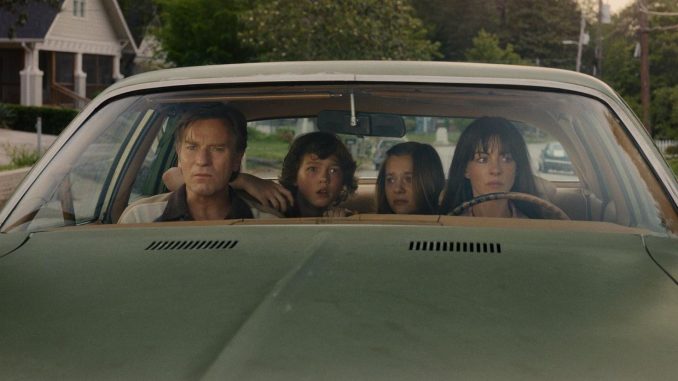
“The End of Oak Street” is the rare summer blockbuster that remembers movies can be both crowd-pleasing and slightly strange. David Robert Mitchell’s 2026 science-fiction survival film drops a 1982 Michigan cul-de-sac into the Mesozoic and then asks what a strained American family does when the lawn furniture is suddenly surrounded by things that want to eat it. An 8.8 out of 10 feels earned: the picture is lean, sincere, visually striking, and anchored by Anne Hathaway at her most grounded and ferocious.
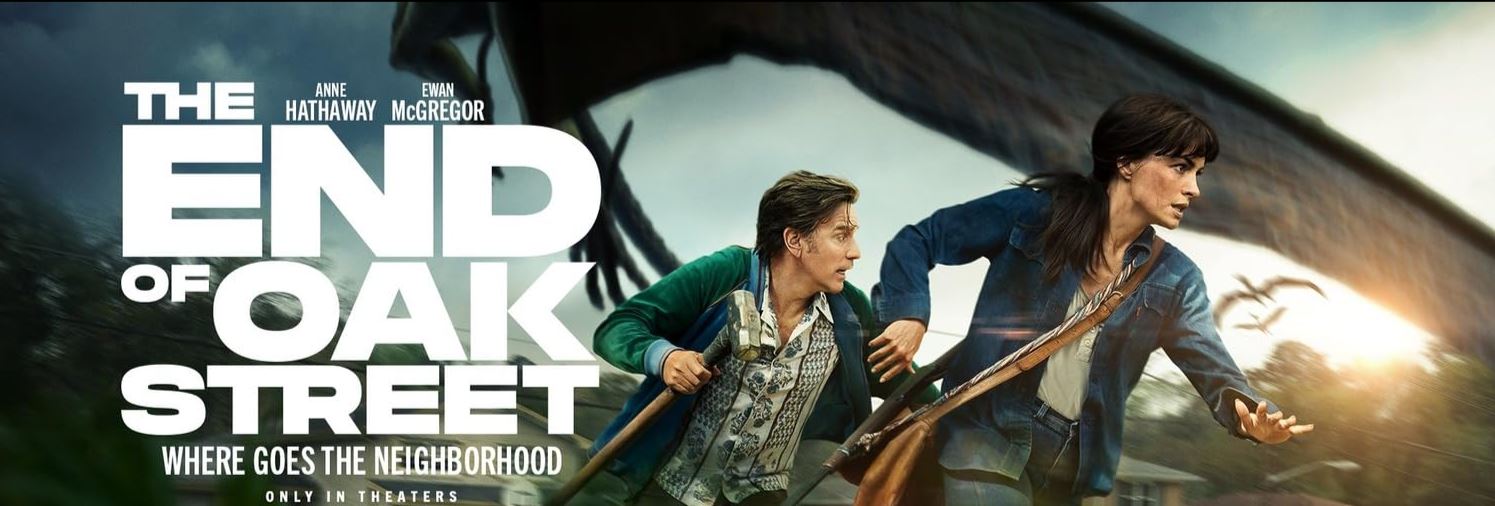
The setup is almost comically direct. One night a cosmic event shears Oak Street out of suburbia and deposits the entire neighborhood in a prehistoric landscape. Denise Platt, an aspiring novelist played by Hathaway, wakes to ferns the size of houses, a sky that no longer matches the weather report, and the slow realization that the family she was already thinking of leaving now has to stay together or die. Her husband Greg, a laid-off pizza-delivery driver given a sly, weary charm by Ewan McGregor, is the kind of man who has been hiding bad news for weeks. Their children, Audrey and Brian, are typical early-eighties kids until the world ends. The dog, Starbuck, is the only one who seems immediately at home.
Mitchell, working from his own script and with J.J. Abrams among the producers, refuses to treat the premise as a joke. The first act is all texture: block-party awkwardness, cassette tapes, the particular boredom of a marriage that has gone quiet. Then the ground moves and the film becomes a siege movie without ever abandoning the family-drama spine. That combination is what separates it from the louder Jurassic sequels it will inevitably be compared to. The dinosaurs are spectacular, but they are not the point. The point is whether these four people can look at one another again. Hathaway is the film’s secret weapon and its loudest advertisement. Denise is not a superhero mom. She is tired, privately furious, and suddenly required to become competent in ways no one asked for. Hathaway plays the role with a low-boil intensity that never tips into camp. When she finally takes charge, it feels like a character decision rather than a studio mandate. You believe she would rather be writing in a spare bedroom than running from a Spinosaurus, and that reluctance makes every later choice land harder. McGregor matches her by doing something equally unshowy. Greg is not a buffoon, just a man who has let disappointment calcify. The film gives him a few moments of genuine cowardice and then, more interestingly, a few of unexpected grace. Their scenes together after the event have a lived-in awkwardness that most disaster movies skip. The kids, Maisy Stella and Christian Convery, are allowed to be frightened and selfish and occasionally heroic without becoming mascots. Stella in particular has a watchful quality that keeps Audrey from turning into the usual teen-scream template.
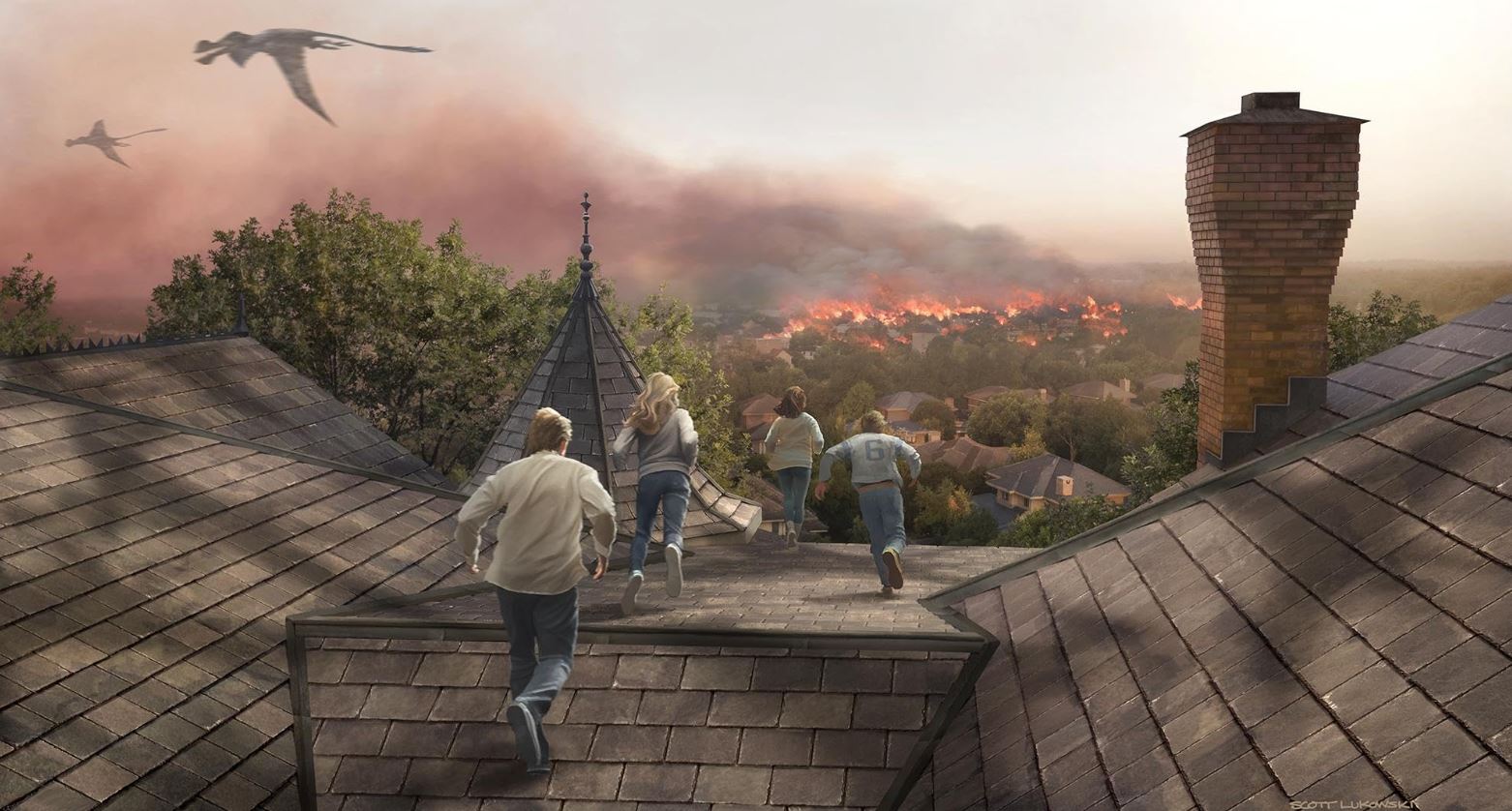
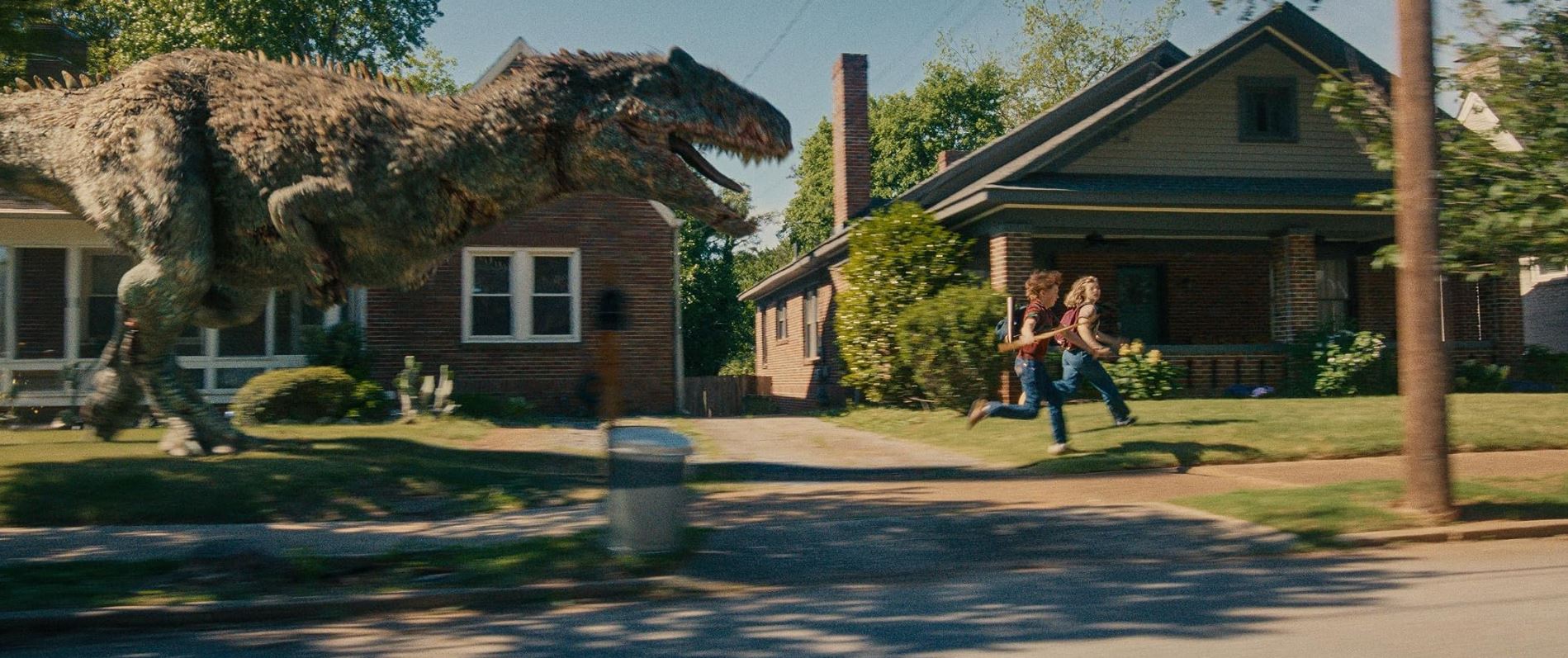
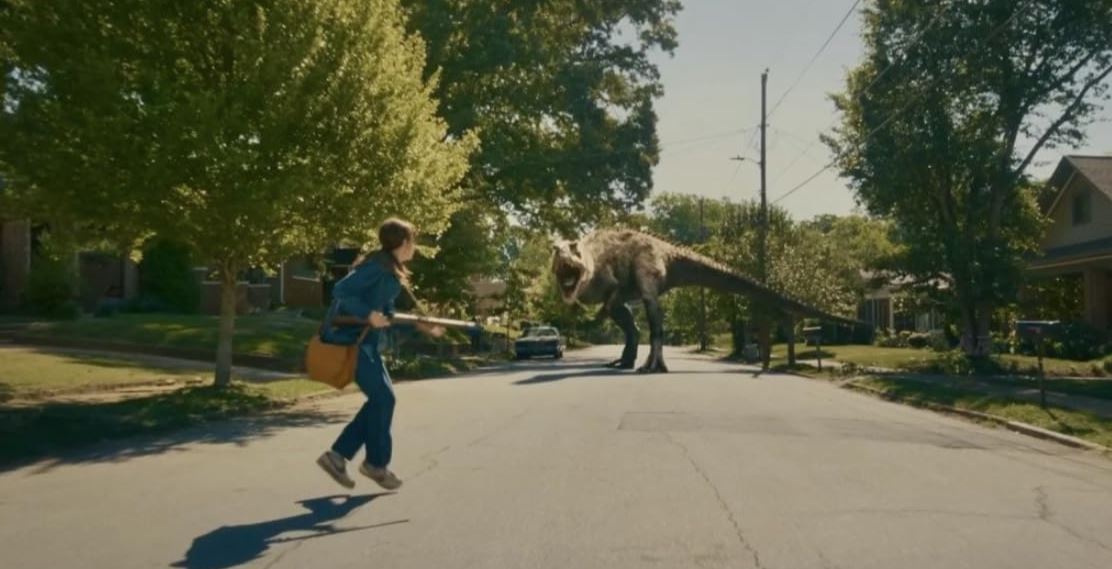
Cinematographer Michael Gioulakis shoots the suburban houses like they are already fossils. The 1982 production design is exact without becoming a costume-party joke; the period details feel like evidence of a life that has been interrupted rather than a nostalgia reel. Once the flora changes, the same camera language continues: wide, slightly ominous frames that treat a T. rex crossing a cul-de-sac with the same matter-of-fact dread as a neighbor arguing over a fence. Michael Giacchino’s score knows when to swell and when to stay out of the way. It is one of his more restrained, effective jobs.
The creature work is first-rate. Practical and digital effects blend well enough that you stop cataloguing method and start watching behavior. These animals feel like animals: territorial, hungry, sometimes oddly beautiful. A sequence involving a herd moving through what used to be a backyard barbecue is both funny and sincerely terrifying. Mitchell understands that the best monster movies let you look at the monster long enough to feel something besides panic. He also understands when to cut away. The film is only ninety-nine minutes, and that discipline shows. The middle stretch is the strongest. Survival logistics—food, water, which houses still have power, which streets are now hunting grounds—are handled with a matter-of-fact tightness that recalls better 1970s disaster pictures. The family arguments do not pause for the dinosaurs; they get worse because of them. That is the film’s smartest trick. Spectacle does not resolve character. Character has to resolve itself while the spectacle keeps arriving. When the Platts finally move as a unit, it feels earned rather than inevitable.
Thematically, “The End of Oak Street” is about the end of a certain American fantasy: the idea that a quiet street, a stable job, and a nuclear family are enough to keep the world out. The dinosaurs are only the most literal version of that intrusion. Denise’s desire to write, Greg’s shame about work, the kids’ restlessness—all of it was already there before the sky tore open. The prehistoric setting simply makes the existing fractures impossible to ignore. That is why the 8.8 rating feels right. The movie is entertaining first and thoughtful second, but the thought is real. Hathaway’s performance will likely be the thing people remember longest. In a year when she has already appeared in several high-profile films, this is the one that feels most like a character study smuggled inside a popcorn movie. She never winks. She never treats Denise as a vehicle for star power. The result is a woman you can imagine surviving this and then having to live with the memory of it, which is a rarer quality in this genre than another well-rendered predator.
The ending, which I will not spoil in detail, has a twisty aftertaste that some will find too clever and others will find exactly right. It does not undo the emotional work of the previous hour and a half. It complicates it. Mitchell has always been interested in the idea that the strange thing you survive is still waiting for you in some form. Here that idea is given a suburban, family-shaped container. Whether the final images land as hopeful or quietly horrifying depends on how much you trust the Platts—and how much you trust the movie’s willingness to leave a few doors open.
Technically the film is a pleasure. The sound design of distant calls and suddenly close footsteps is excellent. The editing by John Axelrad keeps the ninety-nine minutes from sagging even when the family is hiding rather than running. Warner Bros. and Bad Robot have delivered a mid-budget-feeling event movie that still looks expensive where it needs to. In an era of bloated runtimes, the compactness is itself a statement.
Comparisons to “Jurassic Park” and “Poltergeist” are inevitable and not entirely wrong. Hathaway has said the latter was on her mind when she read the script. Mitchell’s version is less haunted-house and more haunted-neighborhood: the familiar made alien by scale and time. What he adds is a contemporary skepticism about the family unit even as he insists it is the only thing that might save anyone. That tension gives the film its bite.
At 8.8, the rating is generous but not inflated. This is not a masterpiece of original thought, and it does not pretend to be. It is a tightly made, well-acted, visually confident piece of studio filmmaking that treats its audience like adults who still want to be thrilled. In 2026 that combination is rarer than it should be. Anne Hathaway carries the picture without seeming to strain. David Robert Mitchell proves he can work at this scale without losing the oddness that made his earlier films distinctive. Oak Street ends. The movie, thankfully, does not feel like it does.
© 2026 CoastalCarolinaNews.com. All rights reserved.

Be the first to comment