
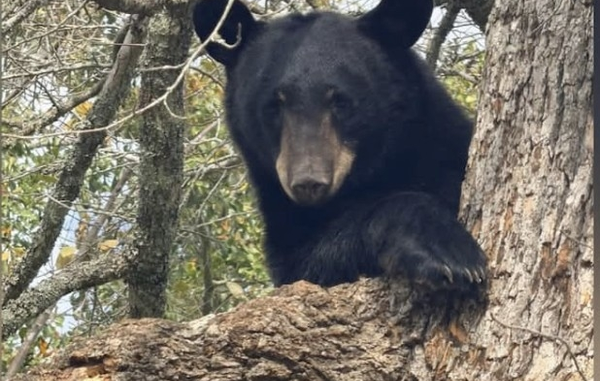
Whiteville, NC — A recently sighting of a large black bear resting high in a tree along Whitehall Road near Whiteville has drawn significant local attention, serving as a timely reminder of the wild neighbors inhabiting the swamps, pocosins, and hardwood bottoms across Columbus County.
As autumn progresses, local black bears enter a phase known as hyperphagia, a period of intensive biological feeding during which they actively search for high-calorie food sources to build necessary body fat reserves before winter. State wildlife experts note that during this fall feeding push, bears can consume up to 20 thousand calories a day, making them unusually active across farmland, timberlands, and rural residential areas.
In Columbus County, abundant agricultural crops such as corn and peanuts, along with acorns and natural brush, naturally attract foraging bears, though human attractants like household garbage, outdoor pet food, and backyard bird feeders can easily draw them toward neighborhoods and rural roadways.
Seeing a black bear in a tree—whether along Whitehall Road or near surrounding swamps—is standard, natural behavior rather than a sign of distress. Black bears routinely climb trees to escape human activity, rest, or seek a safe vantage point when startled by nearby traffic or neighborhood noise.
State wildlife guidance cautions that when a bear is spotted in a populated area, crowd control becomes critical, warning that when curious onlookers gather, a harmless situation can quickly escalate and cause bears to display unpredictable behavior.
Wildlife officials strongly urge the public never to approach a bear in a tree or gather beneath it, reminding residents that giving the animal space ensures it can climb down safely and retreat back into the timber once quiet is restored.
Drivers traveling along rural county roads are also encouraged to exercise extra caution, particularly during dawn and dusk hours when bears are actively moving across roadways in search of food.
North Carolina wildlife management guidelines emphasize that black bears are naturally shy, non-aggressive toward humans, and prefer to avoid contact whenever possible. State wildlife biologists advise that bears have long adapted to living near people, and it is now up to local communities to adapt to living near bears by eliminating easy, unnatural food rewards.
To minimize potential encounters around home properties, state recommendations include securing household trash inside garages or sheds until the morning of pickup, temporarily removing bird feeders, and feeding outdoor pets portion sizes that are eaten immediately before bringing bowls indoors.
Residents who encounter a bear on foot are advised never to run—as running can trigger a chase response—but to stand tall, back away slowly in the opposite direction, and allow the bear a clear escape path.
By taking simple preventive steps and respecting the seasonal habits of native wildlife, Columbus County residents can safely coexist with local black bears throughout the season.
© 2026 CoastalCarolinaNews.com | Jones Media Partners LLC. All Rights Reserved.
No content from this publication may be reproduced, republished, or used for commercial purposes without prior written authorization from Jones Media Partners LLC. For questions or comments call 910.898.2770 or you can reach out via our Contact Page.


Be the first to comment