
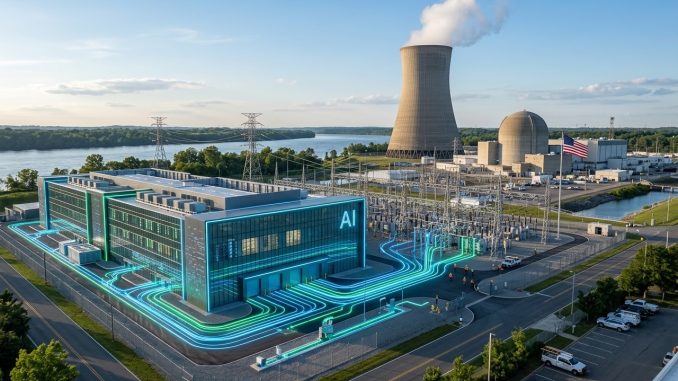
Microsoft and Google-backed energy projects aim to bring shuttered plants back online as artificial intelligence drives surging electricity demand.
REGIONAL/TECHNOLOGY NEWS:
As artificial intelligence continues to expand, some of the nation’s largest technology companies are turning to an unlikely power source: retired nuclear reactors.
Three previously shuttered nuclear plants in Michigan, Pennsylvania, and Iowa are being revived to help meet the enormous electricity demands created by AI data centers. The projects would collectively add about 2.25 gigawatts of power to the nation’s grid, enough to serve roughly 2 million homes and businesses. Federal loans totaling up to $4.4 billion are helping support the effort.
The most closely watched project involves the former Three Mile Island Unit 1 reactor in Pennsylvania, now known as the Crane Clean Energy Center. Plant owner Constellation Energy is working toward a 2027 restart under a long-term power agreement with Microsoft. The facility is expected to produce 835 megawatts of carbon-free electricity.
A second reactor, the Palisades Nuclear Plant in Michigan, is also targeting a 2027 return to service, while Iowa’s Duane Arnold Energy Center could restart by 2029. Google has partnered with NextEra Energy Resources in support of the restart of the Iowa facility.
Industry experts say the trend reflects a growing challenge facing electric utilities nationwide.
AI systems require massive computing power, and the data centers that support them operate around the clock.
Unlike solar and wind generation, nuclear power can provide steady electricity regardless of weather conditions.
The projects are also notable because at least one of the reactors had already entered the decommissioning process after being retired for economic reasons.
Growing demand from technology companies for reliable, carbon-free electricity has helped reshape the financial outlook for nuclear energy, prompting efforts to return some of those facilities to service.
The reactor restarts are occurring in Michigan, Pennsylvania, and Iowa.
While the projects have no direct connection to North or South Carolina and are unlikely to have an immediate impact on local residents, they underscore growing concerns among utilities nationwide about future electricity demand as artificial intelligence continues to expand.
© 2026 CoastalCarolinaNews.com | Jones Media Partners LLC. All rights reserved.


Be the first to comment