
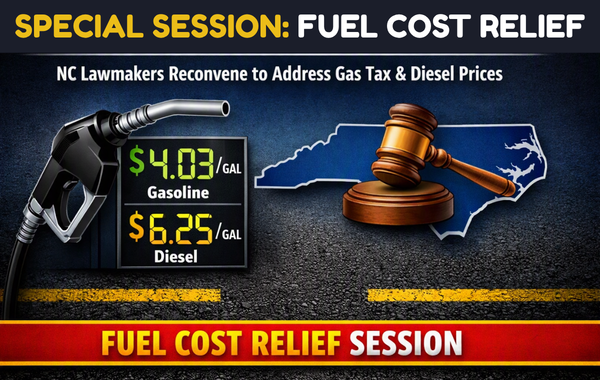
RALEIGH, N.C. — With diesel and gasoline prices climbing to near-record levels across the state, leaders of the North Carolina General Assembly have called lawmakers back to Raleigh this Wednesday to explore legislative relief options aimed at lowering costs for drivers, truckers, and agricultural producers.
House Speaker Destin Hall and Senate Leader Phil Berger announced the special session following weeks of pressure from consumers, commercial haulers, and the farming community. Gas prices across the Tar Heel State have climbed to an average of $4.03 per gallon—up $1.20 over the past year—while commercial diesel fuel has surged past $6.00 per gallon, nearing the state’s all-time record of $6.24 set in September.
Evaluating Gas Tax Changes & State Revenues
A primary focus of Wednesday’s legislative session will involve potential adjustments to North Carolina’s motor fuel tax. At approximately 40.5 cents per gallon, North Carolina currently ranks among the highest states nationally for state fuel taxes.
Unlike many state general funds, the N.C. Department of Transportation (NCDOT) relies directly on motor fuel taxes as its primary revenue engine. The gas tax supplies $1.9 billion of the state’s $2.2 billion roadwork budget within the Highway Fund. Lawmakers are weighing whether to issue a temporary gas tax holiday, cap the variable tax rate, or roll back the per-gallon fee, while assessing how to offset potential revenue drops to ensure highway maintenance and capital construction projects remain fully funded.
Dyed Diesel Waivers & Agricultural Relief
The special session follows recent executive action taken by Gov. Josh Stein. On Sept. 30, Stein directed the N.C. Department of Revenue to suspend state enforcement penalties for operating highway vehicles with red-dyed diesel fuel through the end of 2026.
Red-dyed diesel is untaxed fuel strictly reserved for off-road equipment, agricultural machinery, and heating oil. Normally, using dyed diesel in highway-registered commercial or private vehicles incurs steep tax penalties. Stein’s directive allows agricultural haulers and farmers temporary flexibility during the peak harvest season. The governor has also formally petitioned the Internal Revenue Service (IRS) for a matching federal waiver.
Legislation under consideration this week could codify or expand dyed-diesel exemptions into permanent statutory changes for critical supply chain sectors.
Global and Regional Pressure Points
Market analysts attribute the sharp rise in local fuel costs to a combination of geopolitical conflicts in Eastern Europe and the Middle East, reduced national diesel reserves, severe regional drought conditions, and elevated freight logistics expenses.
Because commercial transport, logging, and agricultural distribution rely heavily on diesel, local businesses warn that elevated fuel costs will continue trickling down to consumer prices at grocery stores and retail counters unless immediate market stabilization occurs.
Proceedings at the State Legislative Building in Raleigh are scheduled to gavel in on Wednesday morning.
© 2026 CoastalCarolinaNews.com | Jones Media Partners LLC
No content from this publication may be reproduced, republished, or used for commercial purposes without prior written authorization from Jones Media Partners LLC. For questions or comments call 910.898.2770 or you can reach out via our Contact Page.


Be the first to comment