
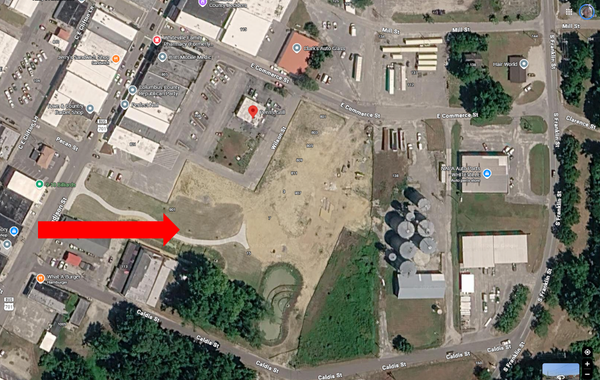
“SHOW US THE 782,000 GALLONS”: Helen Holden of Penns Grill
Whiteville NC – For decades, the merchant corridor of downtown Whiteville has fought a war against water. Sitting square in the low-lying floodplains adjacent to Soles Swamp and Mollie’s Branch, the city’s business district has faced devastating, repeated inundation. A deluge of severe thunderstorms in July 2016 overtopped curbs and inundated storefronts, followed in rapid succession by catastrophic floodwaters from Hurricane Matthew in 2016 and Hurricane Florence in 2018.
The primary culprit has always been a combination of geography and aging infrastructure. Decades of concrete, hardscaping, and heavy asphalt created sprawling impervious surfaces, forcing storm runoff directly onto South Madison and Commerce streets. Aging, undersized drainage pipes and structural bottlenecks along nearby railbeds regularly cause water to back up, turning minor thunderstorms into disruptive flash floods.
The Vision: Madison Street Park
To break this destructive cycle and spark economic revitalization, the City of Whiteville broke ground in October 2025 on the Madison Street Park.
Located at 917 S. Madison Street, the project takes over the roughly 7-acre footprint of the former Lewis Smith Shopping Center—a 1960s commercial complex that was abandoned after taking on repetitive storm damage and suffering a major fire. Because the property rests squarely inside the Soles Swamp floodplain, city leadership deemed it unsuitable for commercial rebuilding, opting instead to engineer a flood-resilient civic green space.
The engineering concept flips traditional development on its head: rather than fighting the floodplain, the park is designed to absorb it. By stripping away acres of old paved parking lot, the project restores permeable soil. Built-in bioswales and constructed retention wetlands are engineered to capture, filter, and temporarily hold excess downtown stormwater before slowly releasing it into the Soles Swamp basin, easing the load on surrounding city storm drains.
Progress, Timelines, and the Phase 2 Funding Gap
While the project was hailed as a major step forward, construction has moved forward in distinct stages—leaving significant uncertainty about its complete capacity.
-
Phase 1 (Under Construction): Funded by a $902,814 grant from the NC Department of Natural and Cultural Resources / Land and Water Conservation Fund, $380,000 from the NC Commerce Rural Transformation Grant, and $116,000 in local contributions, Phase 1 carries a $1.3 million price tag. This initial phase covers essential site grading, demolition, initial walking paths, lighting, an amphitheater/stage structure, and the primary stormwater retention pond.
-
Phase 2 (Status Unfunded): City officials confirmed at the groundbreaking that Phase 2 is currently unfunded. Intended to feature secondary amenities—including a splash pad, expanded playgrounds, picnic shelters, public restrooms, and extended boardwalks over wetland areas—Phase 2 lacks an official construction timeline or secured grant capital.
This funding gap has sparked growing concern among local business owners, who wonder whether a partially completed park can deliver the flood protection the city promised.
“Show Us the Engineering”: Helen Holden Demands Accountability
The frustration surrounding the project spilled into the public eye when Helen Holden, owner of the historic Penn’s Grill at 128 E. Commerce Street and a former Whiteville City Council member, issued a public challenge to city officials and project engineers.
Penn’s Grill, which has operated downtown since 1946, sits immediately adjacent to the new park site and has repeatedly taken on floodwaters during heavy storms. Pointing to a December 20, 2024 project amendment that increased the required detained stormwater capacity from 1.5 acre-feet to 2.4 acre-feet—roughly 782,000 gallons of water—Holden pressed city hall for verifiable engineering data rather than press releases.
In a widely shared statement, Holden voiced the concerns of downtown merchants who fear that recent dirt fill and field modifications on the site may not align with approved plans:
“SHOW US THE 782,000 GALLONS. ‘My Dearest Director’… That’s really what this comes down to… According to project documentation for the Whiteville Stormwater Park, a December 20, 2024 amendment referenced increasing detained stormwater from approximately 1.5 acre-feet to 2.4 acre-feet. 2.4 acre-feet is approximately 782,000 gallons of water. So I have a simple question: WHERE IS IT?”
“I’m not asking for another rendering. I’m not asking for another press release. I’m not asking to be told, ‘The engineers designed it.’ SHOW US THE ENGINEERING. Show us exactly where approximately 782,000 gallons will be detained on the property. Show us the basins. Show us the depths. Show us the storage calculations. Show us the approved elevations. Show us the actual constructed elevations. Show us the inlet and outlet elevations. Show us where the water ultimately discharges. And show us what happens when that downstream drainage system is already full during a flood.”
“That’s especially important because substantial fill has been placed on this property, and questions have been raised about whether portions of the constructed grade match the elevations shown on the plans. This is downtown Whiteville. We already flood… So when a project associated with stormwater management and flood resilience is being constructed in the middle of a flood-prone downtown, asking where the water goes isn’t being negative. IT’S THE QUESTION WE SHOULD BE ASKING.”
“I want this park to succeed. I want downtown Whiteville to succeed. But good projects don’t need to be protected from legitimate questions. GOOD PROJECTS SHOULD BE ABLE TO ANSWER THEM… That’s not anti-progress. That’s accountability.”
— Helen B. Holden, Owner, Penn’s Grill
Unanswered Questions Loom Over Downtown
Holden’s critique underscores a growing rift between downtown merchants and city administrators. Business owners along the Commerce and Madison street corridors continue to ask:
-
Elevation & Grade Integrity: Has the addition of fill dirt on the property altered constructed grades in a way that reduces the overall 782,000-gallon detention threshold?
-
Downstream Capacity Constraints: Even if the park retains 2.4 acre-feet of water, where does the overflow go when downstream receiving streams like Soles Swamp are already cresting during major hurricanes?
-
Reliance on Phase 2: Does the park’s ultimate flood retention modeling rely on secondary drainage components that remain stuck in Phase 2 due to missing funding?
As construction on Phase 1 continues, downtown business owners maintain that transparency is the only path forward. For the merchants who keep their doors open in Whiteville’s historic core, seeing the math behind the flood control plan isn’t just a matter of municipal oversight—it’s a matter of economic survival.
Coastal Carolina News is an independent, locally owned Digital News Platform serving Southeastern NC and Northeastern SC.
For Breaking News Headlines, follow Coastal Carolina News on Facebook!
© 2026 CoastalCarolinaNews.com – Jones Media Partners LLC. All rights reserved


Be the first to comment